Saturday, January 30, 2021

C.S. Lewis and the Joy of Science

I found this as I was rummaging through some older computer files--some thoughts on C.S. Lewis and Joy (the experience, not his wife). I think it's still relevant because, if anything, I see scientific materialism or naturalism (all that exists is the material world) is on the rise.


As Lewis commented himself in Surprised by Joy

“The key to my books is Donne’s maxim, 'The heresies that men leave are hated most.' The things I assert most vigorously are those I resisted long and accepted late.” 

The “heresy” that he left was materialism, or Oxford Realism, for idealism. And then eventually, he turned particularly to Christian faith.


This leads to a famous argument: Human beings seek something that this world cannot satisfy, which points to a God beyond this world. This argument appears in The Problem of Pain and in “The Weight of Glory.” 


What is he saying? Is he arguing that this sense of transcendence—or better, this desire for it, which Lewis calls “Joy”—proves God? 


No, at least not as a deductive proof. Instead Lewis is making a suppositional argument here: We do not fully understand the desire for something beyond (or Joy) itself, but it opens to a wider metaphysical conclusion, one that points to God who created us. 

Or more systematically, the form of this suppositional argument from desire proceeds as follows: Suppose God created this world, we can imagine that God would leave a desire for more than this world offers. We experience a longing for more than this world offers. It is reasonable to see this as pointer to God.
Lewis’s argument from Joy or desire brings to mind the question of whether many of Albert Einstein’s words about “God” were really about, well, God, such as when he commented

“Everyone who is seriously involved in the pursuit of science becomes convinced that a spirit is manifest in the laws of the Universe—a Spirit vastly superior to that of man.” Albert Einstein

Richard Dawkins argues (not surprisingly as the arch-atheist) that this stuff in Einstein isn’t really about God, it’s about transcendence. In his Why Science Does Not Disprove God, the science writer and mathematician Amir D. Aczel, contends (as I understand him) that, no, this is really about the Deity, and in fact, believing in God is profoundly compatible with science. 


And my argument here is that Joy—in Lewis's sense—historically and philosophically, leads to science. I'll leave it there for now.

Friday, January 22, 2021

On Time and Beauty (Some Notes)

Beauty appears to be both temporal and timeless. Every human experience of beauty is in time, and yet, when we experience beauty, we seem to transcend, even to be removed, from time. To understand beauty, it seems to me that we need to figure out time.


I am continually drawn to Augustine’s profound reflections, which are often cited and for good reason, 

“What, then is time? There can be no quick and easy answer, for it is no simple matter even to understand what it is, let alone find words to explain it” (Confessions XI. 14).

What do science, philosophy, and theology say about time?            

The consensus view in physical sciences, following Albert Einstein, is that time and space are related, not independent aspects of reality (as in classical physics). One reason time cannot be entirely relative is what Hermann Minkowski identified as the “causality constraint,” that is to say, even within the relativity of time in an Einsteinian universe, observers in uniform motion find that causes occur before effects. More precisely, causes according to one observer are causes according to all other observers in uniform relative motion. In essence, causality is invariant, not relative.     

From a philosophical perspective, time can be understood (i.e., explained) as phenomenal, but not noumenal (Kant), or as the very structure of reality (Hegel, Whitehead). Similarly, beauty can be viewed as one of the atemporal Transcendentals (Thomas).      

Theological perspectives frequently explain and thus unfold time as a gift from God (Augustine), but are unsure about whether God’s eternity is atemporal (Thomas) or supratemporal (Barth, Russell). 

More personally, I’d like to see how time can be a component of human flourishing and a resource for the common good. 

This reminds me of a psychologist with a remarkable name, Mihaly Csikszentmihalyi. (For what it’s worth, I once heard someone comment that he prefers “Mike” and that his last name sounds something like “Chick-sent-me-high.”) 

In his book Flow: The Psychology of Optimal Experience, my buddy Mike presented a key idea for grasping how we find our passion. In the state of the mind he named “flow,” we experience deep enjoyment, challenge matched by our skills, creativity, and a sense that time is moving in a different, and fuller, way. How can “flow”—or “optimal experience”—be described? He writes 

“‘Flow’ is the way people describe their state of mind when consciousness is harmoniously ordered, and they want to pursue whatever they are doing for its own sake.” Mihaly Csikszentmihalyi

Put another way and drawing from Emanuele Ciancio (“Time Flow in the Natural World: A Theological Perspective”), the beauty of time might be summarize in the Greek New Testament word kairos, which means “opportunity,” or perhaps better, "the fullness of time."

Does human flourishing mean living a beautiful life regularly imbued with kairos

Monday, January 11, 2021

Intrinsic Religion

Being a pastor, or any kind of church leader for that matter, is a tough job (which I know from 18 years experience). And in light of the ongoing effects of COVID (emotional, physical, and otherwise), I've continued to ponder the future of the church in America. 

This has led me to consider the distinction between intrinsic and extrinsic religious life (or in more technical terms, "religiosity"). 

What has led me to this? I've been asked recently to find resources in preparation for a podcast interview on whether scientific research backs up the idea that faith in God (or religion, more generally) is good for us.

From what I'm learning it's about how we approach our faith, or in the literature, our "religion."

Extrinsic or intrinsic religion?

The first, intrinsic religiosity, you do because you want to, and the second, extrinsic religiosity, because you're trying to please others. (By the way, I think this is what a lot of people are getting at with the "spiritual, but not religious" moniker.)

For a bit more clarity, I'll quote the article "Intrinsic vs. Extrinsic Religiosity" that I recently read:

"The intrinsically religious see religion as valuable unto itself.  Instead of religion serving another motivation, religion provides the master motivation.

The extrinsically religious go to church with another end in mind (although likely subconscious). It may be making that new business connection or finding a spouse.  Or it could be psychological security, solace or self-justification."

Some mighty powerful words from the God-Man

If this sounds like Jesus and the Pharisees in the Gospels, it should. 

"Woe to you, scribes and Pharisees, hypocrites! For you are like whitewashed tombs, which on the outside look beautiful, but inside they are full of the bones of the dead and of all kinds of filth." Matthew 23:27

Jesus is en fuego in this passage--he really undoes the "Jesus meek and mild" thing. This topic must have meant something to him. And so it should to us. (Because it's so good, you might want to read all of Matthew 23.)

Something for the church today

So far I've presented the conclusion from the research that we need to be together. But what do we do in light of the current pandemic?

At some point, we are going to emerge from COVID-19 protocols, and as I've argued before, we're not "going back to church" as a culture. That ship has sailed. 

And yet... We do know that, overall, religious life is good for us. I'd be happy to use Christian "spirituality," if that lands better, but just remember that it's the social connections, the "sociality," involved in our lives that makes church so potent for psychological and physical health.

So, we'd better figure out a way to keep the connections, but also grow in our vision for God.

A coda: notes on a way forward

My solution in brief: Outsource the teaching, insource the discussion and hang out. 

In other words, from the scientific research the most important contributions the church can offer is physical co-presence, i.e., being together in the same room. Yes, virtual community can give us something, but we are designed to be together. So, what if not worried less about the content we deliver and let other worldclass thought leaders do that via YouTube et al., while we create more intimate places for discussion? Or at least shoot for 50-50? 

Thursday, January 07, 2021

C.S. Lewis and "You Be You"

There's at least one contemporary expression that I don't fully understand. And honestly, I'm also pondering it in light of yesterday's riots and insurrection in our Capital and what was happening psychologically, both for President Trump and his virulent supporters. 

Was that distorted self-love, or is self-love always a distortion?

At any rate, here it is: "You be you." 

What exactly does this imperative mean?

A word from St. Clive

There are times like these when I wish C.S. Lewis were still with us. Because he grasped the inherent problem. If "you be you" is a form of self-love that implies "and don't give a *whiff* [substitute your word] about others," that indeed is a problem. 

It evokes the age old question of whether self-love is a Christian virtue. I, like St. Clive, have some doubts.


The twisted interpretations of "Love your neighbor as yourself"
For my part, "you be you" sounds a bit too much like what I hear smuggled under the banner of "Self Care" and the rank self-indulgence in America. It also causes Blaise Pascal always rings in my ear: To love yourself implies a level of dishonesty and self-deception because there's fairly icky stuff, some rats in the basement, when we peer into our own souls.

In interpreting "Love your neighbor as yourself," I've repeatedly heard "this means we have to love ourselves." But that's not Jesus's main point. There is no direct command for self-love. Instead, his emphasis is this: We know how we'd live to be loved. So, do the same for others. It's really just another form of the Golden Rule.

And yet, a caveat: I don't want to go too far. It is fine ultimately to love ourselves, but not to start there. And Lewis leads us in the proper order.

Back to CSL
For his part, and as I quoted in the last postC.S. Lewis knew the history the problem of self-love and arrived at an exquisitely concise solution. In "Two Ways of Self," he reminded us that, the Christian tradition, we are loved by God--and thus we can love ourselves
"To love his neighbor as himself, he may then be able to love himself as his neighbor; that is, with charity instead of partiality." C.S. Lewis

Or as he phrased it a bit more creatively in The Screwtape Letters, where the devil Screwtape is describing the aims of "the Enemy" (or God):

“The Enemy wants to bring the man to a state of mind in which he could design the best cathedral in the world, and know it to be the best, and rejoice in the fact, without being any more (or less) or otherwise glad at having done it than he would be if it had been done by another. The Enemy wants him, in the end, to be so free from any bias in his own favor that he can rejoice in his own talents as frankly and gratefully as in his neighbor's talents--or in a sunrise, an elephant, or a waterfall.” C.S. Lewis

Would about the scandalous behavior of our President and how it affected his mob? I think it's "you be you" and self-love gone wild. Would these insights help us today in undue the serious defects in American life? I think so. At least, one can hope. 

Tuesday, January 05, 2021

Does God Want Us to Love Ourselves?

... a question I'm pondering and to which C.S. Lewis has one of the best responses (not a surprise)
“Now, the self can be regarded in two ways.  On the one hand, it is God’s creature, an occasion of love and rejoicing; now, indeed, hateful in condition, but to be pitied and healed.  On the other hand, it is that one self of all others which is called I and me, and which on that ground puts forward an irrational claim to preference. This claim is to be not only hated, but simply killed; ‘never’, as George Mac Donald says, ‘to be allowed a moment’s respite from eternal death’. The Christian must wage endless war against the clamour of the ego as ego; but he loves and approves selves as such, though not their sins. 
 
The very self-love which he has to reject is to him a specimen of how he ought to feel to all selves; and he may hope that when he has truly learned (which will hardly be in this life) to love his neighbor as himself, he may then be able to love himself as his neighbor; that is, with charity instead of partiality. The other kind of self-hatred, on the contrary, hates selves as such. It begins by accepting the special value of the particular self called methen, wounded in its pride to find that such a darling object should be so disappointing, it seeks revenge, first upon that self, then on all. Deeply egoistic, but now with an inverted egoism, it uses the revealing argument, ‘I don’t spare myself’—with the implication ‘then a fortiori I need not spare others’—and becomes like the centurion in Tacitus, ‘More relentless because he had endured.’ The wrong asceticism torments the self: the right kind kills the selfness. We must die daily: but it is better to love the self than to love nothing, and to pity the self than to pity no one.” 

Saturday, December 19, 2020

Live it Like You Mean it

Two days of crisis

I've lived through 9-11 and 11-8, two great and tragic national, and even international, days of crisis. (Some of this will be in my sermon this Sunday at Brambleton Presbyterian Church.)

Most of us know 9-11, the date of the World Trade Center and Pentagon terrorist attacks. But how about November 8, 2018? It was the day I can't forget—when the firestorm ripped through Paradise, CA, moving at three football fields a minute at one point, and burning its way to within about a mile and half of my house in Chico. The Camp Fire represents the most expensive natural disaster in the world that year, with a price tag of $15 billion, and the deadliest in California history.

I mention to underline one point: preparedness can’t happen while you’re in a crisis. We can't learn to care for those suddenly without homes, to pray when our backs are against the wall, and to live compassionately with those in terrible suffering while it's happening. Those are virtues we have to practice before the crises.


Habits: "We are what we repeatedly do"

About a week ago, I was listening to the leading sociologist from Princeton University about his new book on "lived religion." This isn't represented by scholarly texts of religious doctrine or theories about how people should preach (i.e., homiletics), but how we actually pray, how often we participate in worship services, what kind of small group community we're a part of. As Wuthnow writes, "Practicing religion focuses on what people do and say rather than only on what they think and believe."

Living religion is related to famous philosopher Aristotle's virtue ethics. It what cognitive psychology tells us: practices become habits, and habits become character. It's really what I as a Christian have learned from the Jewish roots of my faith, which calls it halaka, or "walking" in the way of God. 

What we practice. What we do is what we become. In fact, our practice becomes a habit and might even change the world.


Coda: "Does this mean we earn our salvation”?

Some of you might be concerned that this implies we earn our salvation. 

Put simply: No. We are assured of our salvation, and this is Jesus's call to discipleship and simultaneously his offering of abundant life (John 10:10).

Listen again to how Paul sets this so brilliantly in Philippians 2:12-13: 

"Continue to work out your salvation with fear and trembling, for it is God who works in you to will and to act in order to fulfill his good purpose." 

Put a little more clearly perhaps, we work out what God has worked in

Or perhaps better, we walk out what God the Spirit has empowered us to do. 


Friday, December 11, 2020

Peace in the Puzzle

The theme for this post is peace, which is related to a couple of pieces (yes, pun intended) I'm working ona sermon for Brambleton Presbyterian Church and the Science for the Church newsletter.

Three insights I discovered along the way... 

A key word from the Beatitudes lost in translation

When I first learned Greek at Cal, one day we were reading Matthew 5:1-12. My professor instructed us that we could translate Jesus’s word in the Sermon on the Mount this way: “Blessed are the peaceful” instead of “peacemakers

He was a great professor, and he opened the New Testament to me in many ways, but here his own leanings toward the interiority of spiritual life—he also lived in an ashram—frankly biased his interpretation of this word. 

And so I arrive a truly profound Greek word study: the word for "peacemaker" eirenopoioi combines two words, “peace” and “make.”

This means that the Beatitudes are not simply the "Beautiful Attitudes." When Jesus, the Prince of Peace (Isaiah 9:6) came to earth, he called us to make peace. And that's significant.

I do realize that what I've said here may lead some to ask, Does this mean we earn our salvation? No, it means we work out what God has worked in (Philippians 2:12-13). Actually better than "work out" in the Jewish context is "walk out" because the key image for devotion to God in Jewish thought is halakha, or "the way of walking."


Peace now and then
Just yesterday, I read that even as former South Carolina Governor David Beasley accepted the Nobel Peace Prize on behalf of the United Nation's World Food Program, while Rush Limbaugh declared there can be no peace between liberals and conservatives and that “we’re trending toward secession."

Yikes! It's hard not to despairand then I remembered Jesus's time was no less contested, which I discovered this article on the New Testament Greek word for "peace."
The New Testament was written in a time during which the Romans overran countless peoples and frequently resorted to mass torture and genocide in dealing with resistance, and the quest for peace was not a romantic one but came with widely felt urgency. Jesus' famous statement "knock, and the door will open" (Matthew 7:7, Revelation 3:8) is not about heavenly doors because in the Biblical model heaven has no doors, but rather about the great War Doors of the temple of Janus Quirinus in Rome. In times of peace these doors were closed amidst great imperial fanfare, and the greatest door-closing festivals were held during the reigns of Nero and Vespasian, just prior and right after the Great Jewish Revolt and subsequent destruction of Jerusalem in 70 AD. [By the way, the name of the city means "in awe of peace, teaching peace"]


Peace and reconciliation through "fractal communities"
Just a few days ago, I had a breath-taking conversation about race and science and faith with Elaine Howard Ecklund and Cleve Tinsley IV. Among many insights, Cleve said that relationships help us move past the endemic racism in our country. He referred to Adrienne Marie Brown’s concept of “fractal community,” which, of course, borrows an image from mathematics and is a kind of science and faith connection, which I love. At any rate, Cleve reminded us: this is the way of Jesus. Where these relationships are, that’s where we see the reign of God. And as he summarized, “I think we really do change the world then.”

And maybe we can. Maybe we make peace.

Friday, December 04, 2020

On Time

I think a lot about time. You might say, I spend a lot of time thinking about time. 

And here are two core convictions: Time is a gift. And we spend time on what we love. I'll add to those, since it's the season of Advent, that when God comes to us in Christ in the Incarnation and inhabits time, God sanctifies time. This post then is what sanctified time looks like.

Speaking of the Incarnation, perhaps the most profound and counter-intuitive statement Jesus spoke was this: “Where your treasure is, there will your heart be also” (Matthew 6:19). 

Without reflection, we might think he said the reverse: where our heart is, there our treasure will be. In this version of Jesus, we adjust our inner attitude, and then we do the right actions. 

But the order is different, and that fact is critical: “Where your treasure is, there will your heart be also.”Our hearts follow our treasures. I.e., what we spend our time is what we love, and the more time we spend the more our love grows. Invest your time in a church or nonprofit and see how you begin to care more about it. 


But why then do I often spend my time so poorly? Why do I not inhabit the present moment?


The problem is that we seem to live in every other time but the present. We throw away our time like it's dispensable. We don't treasure it. 


Blaise Pascal, the brilliant seventeenth-century scientist and theologian, offered a profound meditation on this topic: 

Let each of us examine his thoughts; he will find them wholly concerned with the past or the future. We almost never think of the present, and if we do think of it, it is only to see what light it throws on our plans for the future. The present is never our end. The past and the present are our means, the future alone our end. Thus we never actually live, but hope to live, and since we are always planning how to be happy, it is inevitable that we should never be so. (italics added)

Or as the brilliant writer, Anne Lamott puts it, God wants to give us the child’s experience of “big, round hours." 


This thought, like so many, takes me to St. Clive, aka C. S. Lewis, who puts the problem of human existence—or better the ongoing temptation of time—into the mouth of a devil, Screwtape in his fictional correspondence,The Screwtape Letters. 


Screwtape writes to his junior devil, Wormwood, that “we want a man hag-ridden by the Future” because in essence the future does not yet exist and it takes his eyes off the present moment. 

"We want a whole race perpetually in pursuit of the rainbow's end, never honest, nor kind, nor happy now, but always using as mere fuel wherewith to heap the altar of the future every real gift which is offered them in the Present."

And now back to Pascal; this also comes from Pensées

"So imprudent are we that we wander in the times which are not ours, and do not think of the only one which belongs to us; and so idle are we that we dream of those times which are no more, and thoughtlessly overlook that which alone exists.” 

Friday, November 20, 2020

The Buddha: Enlightened or Awakened?

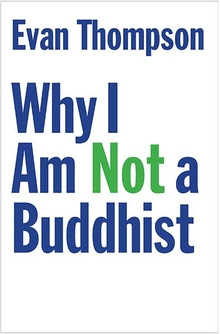
I'm reading a fabulous book by Evan Thompson on Buddhism, and particularly its relationship with science, Why I am Not a Buddhist.
Here's one tidbit.

Thompson is a 
philosopher who's spent considerable time in Buddhist communities, including conversations with the Dalai Lama. Even if not himself a Buddhist (as the title clearly states), he considers himself "a good friend to Buddhism." 

On to an historical note... Max Müller, in the 19th century, shifted the  translation of "the Buddha," from "Awakened One" (which is closest to the Sanskrit verbal root, budh, meaning "to awaken") to "Enlightened One." That shift is significant. Thompson states that it provided a way to make the Buddha's life fit with ideas of enlightenment swirling around in Europe at the time.

The problem for us (especially those who don't speak Sanskrit) is that when we think about "enlightenment," Immanuel Kant and the Age of Enlightenment come to mind. It was Kant who declared that we must throw off our "self-imposed tutelage," and thus (to put it in contemporary slang) "find our true self."

But the Buddha found that there was no self, and that realization is the basis of achieving nirvana... that was his awakening. The problem then, especially when we contemplate forms of science, is how Buddhist meditation and its awakening connects with neuroscience. 

Enough to ponder for this post...


Friday, November 13, 2020

"After Trump" by Don Heinz

I just read the book, After Trump: Achieving a New Social Gospel, penned by my colleague and friend, Don Heinz. 

Here are few comments adapted from my endorsement on Amazon.
Packed with insight and perfectly timed, Heinz imagines a world “after Trump” in which Christians formulate—and more importantly, embody—a new social gospel for the 21st century. This book will certainly appeal to those who yearn for a movement “that would redeem American Christianity in the time after Trump.”

How can this happen? Heinz argues that, by taking seriously God’s liberating love—the love that freed the Israelite captives and took them out of Egypt, the love that is incarnate in Jesus and his ministry of transformation, a new movement can find its inspiration.

As a student of American religion—particularly where it’s headed with the increase of the not-religiously-affiliating, or the "Nones"—I appreciate how Heinz roots these reflections in American soil. A few favorite examples: his insights about Robert Bellah’s “civil religion” and Jonathan Winthrop’s “city set on a hill,” as well Charles Taylor’s Secular Age (and why we can’t take recourse in a simple slogan of “science vs. religion”).

All in all, Heinz does not argue for a new “Christian” political party, but a new movement of the social gospel, learning from, but not restricted to, Walter Rauschenbusch et al.’s famous early 20th century formulation.
In sum, as Heinz puts it, this book is “an invitation and a manifesto.”

Will this movement happen? 

It’s now time to see, but one can pray for a more just, socially engaged, and faithful nation. And I suppose Heinz might add that it depends on those of us who call ourselves followers of Christ to decide what we will do. After Trump. 

Friday, November 06, 2020

My Conversation with John Lennox about St. Clive

Today, I interviewed Doctor John Lennox, Oxford University mathematician and Christian apologist. He’s authored several books, such as Can Science Explain Everything? and most recently, 2084 Artificial Intelligence and the Future of Humanity. The upcoming film Against the Tide features Doctor Lennox’s thought.

This is one part of our conversation I really enjoyed, which I start in medias res...

Lennox

... a professor of Latin and Greek introduced me to the classical world, and so the humanities are as important to me as the natural sciences. Being a linguist fits with mathematics because it's a specialized language, and therefore the idea of clear explanation is very important. 

C. S. Lewis once said, as you probably know, if a person cannot explain what they believe with words that people can understand either they don't believe it, or they don't understand it.

I'm constantly looking for ways or stories that aren't arbitrary, but enable us to get a grasp difficult concepts. Lewis was a genius.

Cootsona

Lewis is the greatest at this that I know of.

He had so many great images, and I was think you might be referring to the essay that lecture he gave to Anglican youth pastors, where he said there should be an exam for every ordination where you must translate things right into the common language. 

And oh boy, we could really get lost in Lewis. I loved in the Oxford Socratic Club, his response to Doctor Pittenger, where he says, I have always wanted to speak for the people, right? And that means that I'm going to have to round off some edges, which is hard for academics. 

I've given different presentations where I've talked to academics and said we need to learn from Lewis. Because we need to communicate, if we have great ideas, especially as people of Christian faith. But we have to realize there's going to be a loss because it's not going to sound as precise. Academics also like to hide sometimes behind their language. 

Lennox

I fear they do. They do indeed.

Cootsona

You have a boldness about you, which I think is really compelling.

Lennox

A thought can be both clear and deep, and sometimes people have the impression that unless they use virtually unintelligible high flow language.

They're not really coming across as intellectuals, and a lot of it is human pride. Of course, yes, Lewis wanted to speak clearly and to articulate profound ideas at levels that people could grasp. Part of them and that really is a goal.

And he's a model for for me in that way.

Saturday, October 31, 2020

Science and Two Ethical Systems: Buddhist and Christian

Buddhist ethics and science
In his brilliant book, 
Morals Not KnowledgeJohn Evans has argued that 
“Religion and science are the two great ways of understanding the world, but by understanding I mean the relationships between humans in the world and the relationship between humans and nature. These are stuff of morality….” John Evans
Even more, Evans asserts when conflict between the two occur, the lion’s share happens at the level of “morals, not knowledge” (and thus the title of the book).

This conflict obviously rears its head for many with "God or evolution." Since that's often true in our country, where Christianity is the dominant religion, what about Buddhists? The simple answer: they don’t carry this burden, partly because they don't believe in a Creator God. 81% of American Buddhists accept evolution. Pew Research states quite simply, 
“Many Buddhists see no inherent conflict between their religious teachings and evolutionary theory. Indeed, according to some Buddhist thinkers, certain aspects of Darwin’s theory are consistent with some of the religion’s core teachings, such as the notion that all life is impermanent.” Pew Report
I mention this because if one begins with the connection of all sentient life, like Buddhism does, then it’s not hard to links to evolutionary thought. In fact, the Buddhist scholar Inoue Enryo argued that Buddhism can embrace evolutionary thought because it holds to “no sharp distinction between humans and animals as Christians claim….” 

Moreover, it’s therefore no grand step to the Buddhist commitment to ahimsa, or non-violence, for all sentient beings. This, of course, can come into conflict with scientific research, especially animal testing. In their research collected in the book, Science and Secularity, Elaine Howard Ecklund and her colleagues quoted a Taiwanese biologist commenting, “Buddhism is about not killing.” 

Christian ethics and s
cience
Recently, when I was talking with a pastor who heads a Hispanic Christian ministry, he told me this, “Many Latinos drive trucks. And, in the next ten years, those jobs will be lost to Artificial Intelligence. I want to encourage my flock to be creating AI.” The effects of technology and science often displace jobs, and so we arrive at justice, one of the ethical foundations of Christianity (which it, of course, adapts from its Jewish roots).

Many believers see Christianity, like many other religions do, as a way of life, not ultimately intellectual content. Again to draw from Evans, “Evolution versus creation,” for example, isn’t ultimately about doctrine, in this view, but about the implications for ethics. Does the theory of natural selection lead us to see all people as simply the products of blind, undirected processes? Not really, as I've posted before, but that's where the conflict starts.

Among other insights from her social scientific research, Ecklund has similarly highlighted that Christians are particularly drawn to sciences that involve healing—i.e., ethical action in the world that reduces suffering. In her book Why Science and Faith Need Each Other, Ecklund observes that Christians and non-Christians both express “a great deal of confidence in medicine.” This correlates with a focus on Jesus, who is reported in the Gospels to be a healer. As Ecklund observes,
"Jesus’s ministry on earth involved touching those whom others would not touch, healing those whom others thought were beyond healing. Christians holding this theological view can see medical technologies as created by God for us to use to relieve our suffering and the suffering of others." Elaine Howard Ecklund
Philip Clayton has highlighted stem cell research, warfare technology, CRISPR gene editing, and he reserves his attention for global climate and sets Christianity within the “three Abrahamic faiths [which] go back… to the Book of Genesis, which calls believers to cultivate care for the earth.” Nature for them is “a creation of God and therefore a thing of great value.” This indeed leads to ethical action not simply for other humans, but for the Earth.

Saturday, October 24, 2020

C.S. Lewis: From Creation to Creator

I also call this "a theology of nature with a touch of Lewis." (It is also an excerpt from this post.)


Several options exist that link nature—and thus science, which studies nature—with how we understanding God. The physicist and theologian Ian Barbour is often associated with the concept of "a theology of nature." It's more or less what I’m outlining here. 

Daniel Halverson describes it as follows: 

“Where natural theology tries to understand God in scientific context, theology of nature tries to understand nature in theological context.” Daniel Halverson

A Christian theology of nature asks this first: "What we can infer about nature from the God we know in Jesus Christ?" Second, it integrates these inferences with scientific discoveries.

And this brings me to C. S. Lewis, who presented a similar view to a theology of nature. It is part of his famous array of apologetics, and one that resonates with all kinds of people: 

“If I find in myself desires which nothing in this world can satisfy, the only logical explanation is that I was made for another world.” C.S. Lewis

Lewis concluded that the only satisfaction for our desire for something more than the natural world has to offer is God.

Many call this Lewis’s "Argument from Desire" (which I've discussed in this blog post and here).

Let me pause to consider Ecclesiastes 3:11: God “has also set eternity in the human heart….” This means our hearts search for the Eternal God. Nature—even our human nature—is a sign, but it is not the end, of our journey. God alone is. The Cognitive Science of Religion (CSR) supports Lewis. In analyzing the structure of the human mind, CSR finds a natural openness to God. 

In 1941 Lewis preached his brilliant sermon “The Weight of Glory.” It is, in my view, one of the greatest ever preached. He presents a form of the argument from desire by calling out in his listeners their desire for beauty. They cannot satisfy this desire cannot in the things of the world, “but through them, and what came through them was longing.” 

Ultimately, Lewis linked this longing with God, the Source of beauty. 

“We are summoned to pass in and through Nature, beyond her, into that splendor which she fitfully reflects.” C.S. Lewis