Showing posts with label American religion. Show all posts

Thursday, November 14, 2019

Being Born Again and Again

Here's a little something pulled from my upcoming book, Negotiating Science and Religion in America.

The topic--a religious revival--is also worth taking in as we watch Kanye West tour the country and bring what many are calling a new surge of God's Spirit. (It's attracted the attention of Joel Osteen and the American Bible Society.) 

I remain open--and I've always liked Kanye's music--but I'm not yet convinced this is really a reviving of our country's spiritual life. At any rate, here I look at the question of whether revivals are beneficial. They certainly are American!

A central component of the story of America is the sensational change that religious revivals promise. As Winthrop Hudson makes clear in his classic, Religion in America: An Historical Account of the Development, one effect of the various revivals was missionary zeal: 
“Above all, this surging tide of evangelical religion supplied a dynamic which emboldened the Protestant churches of America to undertake the enormous task of Christianizing a continent….” The late Princeton University historian Winthrop Hudson
Our country maintains a revivalist zeal and the distinctive hope that life can begin again. To our continual human question, Can I change?, revivals offer a resounding unmitigated Yes. And for a country founded by people seeking the New World, definitive spiritual renewals fit beautifully. As the Romanian poet Andrei Codrescu once quipped, 
“The spiritual pastime of Americans [is] getting born again, over and over.” Romanian poet Andrei Codrescu
A radical moment of change or conversion indelibly marked our consciousness and hopes. Instead of continual incremental change—e.g., the notion of kaizen, cherished by Japanese culture—we applaud radical, dynamic disruption, with lives marked by a specific before and after. But, of course, revivals don’t always deliver.

P.S. Insofar as this is a blog about faith and science, and about what makes a flourishing faith, fully alive, revivals tend to direct Americans away from the rationalizing side of life--the "head," as it were--that we associate with science. America has exhibited a dialectical relationship with science and religion, often expressed with rationality and order on one side in contrast with conversation, feeling, and intuition on the other. In James Gilbert’s view,
Science and religion “are words suggesting two great and opposing philosophic systems—materialism and idealism—that, in a variety of forms, operate as polarities in American culture.” Historian James Gilbert
Head vs. heart? Materialism vs. idealism?  Are these dichotomies that we're facing right now? What would a true revival tell us about how we relate science and religion today?

In the end, this revival (if it is one) may not be so much a rejection of our culture's saturation in science and technology as about Kanye's fame.

Thursday, September 26, 2019

The Limitations of Common (Mis)Conceptions

This blog is broadly about a flourishing, fully alive faith.

Because science has riches to offer our faith, sometimes as a challenge, but even more as a resource, these posts often address topics in science and religion.
This time I’m addressing the complexity of understanding that latter term. 

Why? I read two articles this week that made it really difficult to stick with stereotypes and their (mis)conceptions about religion in American. They also touch on topics of particular relevance in light of the opening of an impeachment inquiry.

The first posed the question, “Who’s an evangelical and who gets to decide?”

It noted that Beth Moore, the fabulously popular evangelical speaker, and Southern Baptist Convention leader Russell Moore, and even (I added “even” since he so often seems a walking stereotype of conservative evangelicalism) John Piper the notable pastor and author—all “white evangelical” leaders—have expressed significant concerns about President Trump. Not everyone is Jerry Falwell, Jr.
—a fact I'm quite thankful for. 

But even more, it demonstrated how… well, I’ll just quote it,
“Nonwhite evangelicals, especially African Americans, Asian Americans and Latinos, were less enthusiastic about Trump. Polls often exclude such nonwhite evangelicals by design, as stories about ‘evangelicals and politics’ typically only look at “self-identifying evangelical white Republicans and politics.” Article, "Who's an evangelical and who gets to decide"? 
What seemed like a simple association—"evangelical” implies "Trump supporter"—became much nuanced, and to my mind, exceedingly more interesting.

The second was not actually an article, but a rather extensive report by the Pew Research Center with a somewhat boring title, “The Religious Typology,” but explosive implications—by which I mean, if we take this seriously, our stereotypical ideas about American religion will be exploded.

Pew's new religious typology breaks Americans into seven categories with much more captivating titles like Diversely Devout (traditionally religious, but open to reincarnation and psychics), Relaxed Religious (religion important to them, but not engaged in traditional practice), and Spiritually Awake (skew more toward New Age and untraditional religious practice). About 43% of Americans are in these three—spiritually open, but not entirely religious identified.

Since I can’t leave politics this week, the 12% Pew found to be God and Country—these fit most closely with the white evangelicals that support Trump. That’s like 1 in 8 Americans. These are the engaged Trump supporters. Not all evangelicals are full-throated in their support of the Republican Party and our President? Case closed? Not quite—but minimally some new insights.

All this reinforces what I discovered when I was writing Negotiating Science and Religion in America,

“'One day I woke up and wondered: maybe today I should be a Christian, or would I rather be a Buddhist, or am I just a Star Trek freak?'” And so Leigh Eric Schmidt begins his 2012 book on the American individualized spiritualty, Restless Souls: The Making of American Spirituality in which he demonstrates that, while plenty of contemporary examples exist, so do precedents in our country’s history, and also charts (as Wade Clark Roof describes it inside its cover) the 'lineage from Emerson to Oprah.' Already in the nineteenth century, Philip Schaff described America as 'the classic land of sects,' and John Weiss offered this declaration, which summarizes so much: 'America is an opportunity to make a Religion out of sacredness of the individual.'
The American cultural tradition of religious pluralism, which chooses among various inputs for spirituality, is longstanding and venerable. The past directs our present. Americans have always held copious strands of religious threads in our hands, which we weave together in fascinating ways. An excerpt from my upcoming book Negotiating Science and Religion in America
At times of high political drama, or even when we just want to understand this unusual country, it’s entirely complicated to grasp American religious life—and probably better not to lean on stereotypes and (mis)conceptions.

Thursday, May 09, 2019

"The force of our religious intuitions, and of our impulse to accurate observation and logical deduction"

I'm close to finishing up the manuscript for a book on science and religion in America. At the end, I step back and offer some final reflections. Here's an excerpt of the current version.

If history is a guide, America will continue to blend various forms of belief with unbelief,
rationality and emotion. In that mix, it seems that we as Americans love both religion and science, or what the scientist and philosopher Alfred North Whitehead named 
“The force of our religious intuitions, and the force of our impulse to accurate observation and logical deduction." A. N. Whitehead on religion and science
The curiously American ingredient in this conversation is our dogged insistence on freedom. This often turbulent mix represents a fundamental component to American life, in which we negotiate science and religion’s relationship. Along these lines, historian James Gilbert offered this insight, 
"One of the most creative impulses of American culture is the continuing presence of religion at the heart of scientific civilization." James Gilbert

And what we do in this country resonates throughout the world. We are, to be sure, a remarkably religious people with indicators of religiosity much higher than should be the case for an industrialized nation.This is of course part of what it means to be human. Homo sapiens are Homo religioso—a fact undergirded by contemporary scientific studies

Or as philosopher of technology Lewis Mumford (1895-1990) once quipped, 
“Man does not live by machine alone.” Lewis Mumford
I’ve learned that our work in relating these two poles, represented conveniently by “religion” and “science”—the rational, taxonomizing, and analytic, alongside the emotional, blurring, and synthetic—represent a key part of what it means to be human, and not simply what it means to be American. 

As for those, like myself, who hold to a religious tradition—in my case, an orthodox Christianity—I want my faith to engage with mainstream science. And most Christians do not see a conflict. As Ecklund and Scheitle comment
“After five years of research, here is what we know: Religious Americans of all types are interested in and appreciate science.” Elaine Howard Ecklund and Christopher Scheitle
For the sake of our souls individually and as a nation, we will be at our best when we learn to bring together science and religion into the integrated whole or at least into a détente. It does not seem warranted to insist, along the lines of Richard Dawkins and Jerry Coyne, or Andrew Dickson White and William Draper before them, that these two must fight out to the death. I think that might be the death of our culture’s vitality. 

Thursday, March 07, 2019

Trends: “Nones,” Kinder, Gentler Atheism, and Openness to Something Greater

I’m speaking in two weeks at Arizona State University on the COFAS Conference on Faith and Science
One of my talks is “Future Topics and Trends in Science and Religion With an Eye to American Intellectual History," and here’s some of the material I’m working on, which doesn’t directly address science and faith, but which does address what kind of faith—or perhaps better, spirituality—that increasingly describes Americans.

It would be hard to resist the conclusion that future American religious life will become more splintered and that the Christian church will have a decreasing influence. Almost all major polls of the past five to ten years demonstrate that, as a nation, we are less Christian and affiliated to any religion. For example, the 2014 Pew Research Center report on the Religious Landscape found that 36% of Younger Millennials (1990-1996) and 34% of Older Millennials (1981-89) were unaffiliated (or "nones"), while only 11% of the Silent Generation (1928-1945) could be placed in that category. In between these two fell Generation X (1965-80) at 23% and Baby Boomers (1946-64) at 17%. 

Put simply, in just over sixty years, the percentage of “nones” had more than tripled. The report continues to note that partly this is a generational reality. 
While some Millennials are leaving their childhood religion to become unaffiliated, most Millennials who were raised without a religious affiliation are remaining religious “nones” in adulthood. Two-thirds of Millennials who were raised unaffiliated are still unaffiliated (67%), a higher retention rate than most other major religious groups – and much higher than for older generations of “nones.” (Pew Research Center) 
I have heard it presented that “Oh, they’ll come back to church when they get older, get married, and have kids,” which have been correlations for religious affiliation in the past. Pew doesn’t give religious communities much comfort for the future:
It is possible that more Millennials who were raised unaffiliated will begin to identify with a religion as they get older, get married and have children, but previous Pew Research Center studies suggest that generational cohorts typically do not become more religiously affiliated as they get older. And the new survey finds that most generational cohorts actually are becoming less religiously affiliated as they age. (Pew Research Center) 
And so the future seems largely unaffiliated. But, here I need emphasize that "unaffiliated" doesn’t mean uninterested in God, Ultimate Reality, or spirituality. 

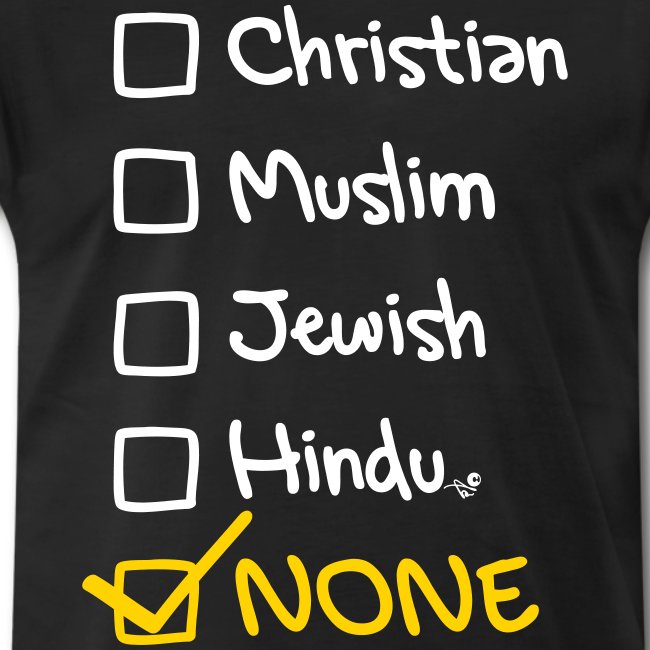
The "nones" check “none of the above” when asked “What religion do you affiliate with?”
Too often, however, the “nones” are thrown in with the atheists and agnostics. This is a category error if we mean that they are all against belief in God or even participation in worship services. They do belong in the same category if the topic is the answer to “Do you affiliate with a particular religion?” 

And this will mean a new future with more pluralized tinkering with spirituality. As Zoe, age twenty, told me in an interview about her views on religion and science: 
“I don’t ever think of myself as a religious person, however I prefer taking pieces of some different religions.” (Zoe, age 20)
And that means some “nones” believe in God and still worship in Christian congregations. And even those who don’t believe in God, find a bigger Something at the core of existence. As Devan, one of the older persons I interviewed, put it, 
“I don’t believe in God, but there is spiritual component to life.” (Devan, age 33)
I’ll leave it observations for now, but I wonder if you have any comments on what this means for our country.